



Every corporate gala tells a story. The challenge is orchestrating that story so deliberately that your guests don't just remember the awards presented—they remember the entire experience as a reflection of your organization's values and vision.
That's where creative production partnership comes in. In Toronto—where corporate galas range from intimate 150-person dinners to 1,000+ guest formal events—the difference between a forgettable evening and one that shapes how stakeholders perceive your brand often comes down to whether you've partnered with a production team that understands both the creative vision and the technical execution required to bring it to life.
This guide walks you through how a full-service creative production approach transforms Toronto gala production, from strategic concept development to flawless execution on the night of your event.
What Makes Corporate Gala Production Different from Other Events
A gala is not a conference. It's not a product launch. It's a carefully choreographed celebration—one where attendees expect polish, attention to detail, and an immersive environment that reflects your organization's prestige and values.
This fundamental difference shapes everything about how you approach corporate gala production in Toronto:
Atmosphere is the message.
Conferences prioritize information delivery; galas prioritize emotional impact. Your lighting design, music selection, scenic staging, and visual content work together to create a branded atmosphere. Information—awards, announcements, remarks—serves that emotional narrative, not the other way around.
Extended runtime requires pacing discipline.
Galas typically run 4–5 hours or more, cycling through reception, dinner, awards, entertainment, and dancing. Your production team must choreograph energy across all these segments, with careful sequencing that prevents attention fatigue and maintains momentum. This is show production, not just equipment rental.
High-stakes moments demand zero-failure execution.
Award presentations, executive remarks, and talent performances are the focal points guests will remember (or not). A dropped audio feed, video sync failure, or lighting mishap doesn't just break the moment—it damages credibility. Redundancy, rehearsal, and on-site technical direction are non-negotiable.
Design coherence across all production elements.
Galas are branded experiences. Your stage design, lighting palette, color grades of video content, and audio mix must all serve a single visual and sonic identity. This requires creative direction from a single source, not cobbled-together equipment.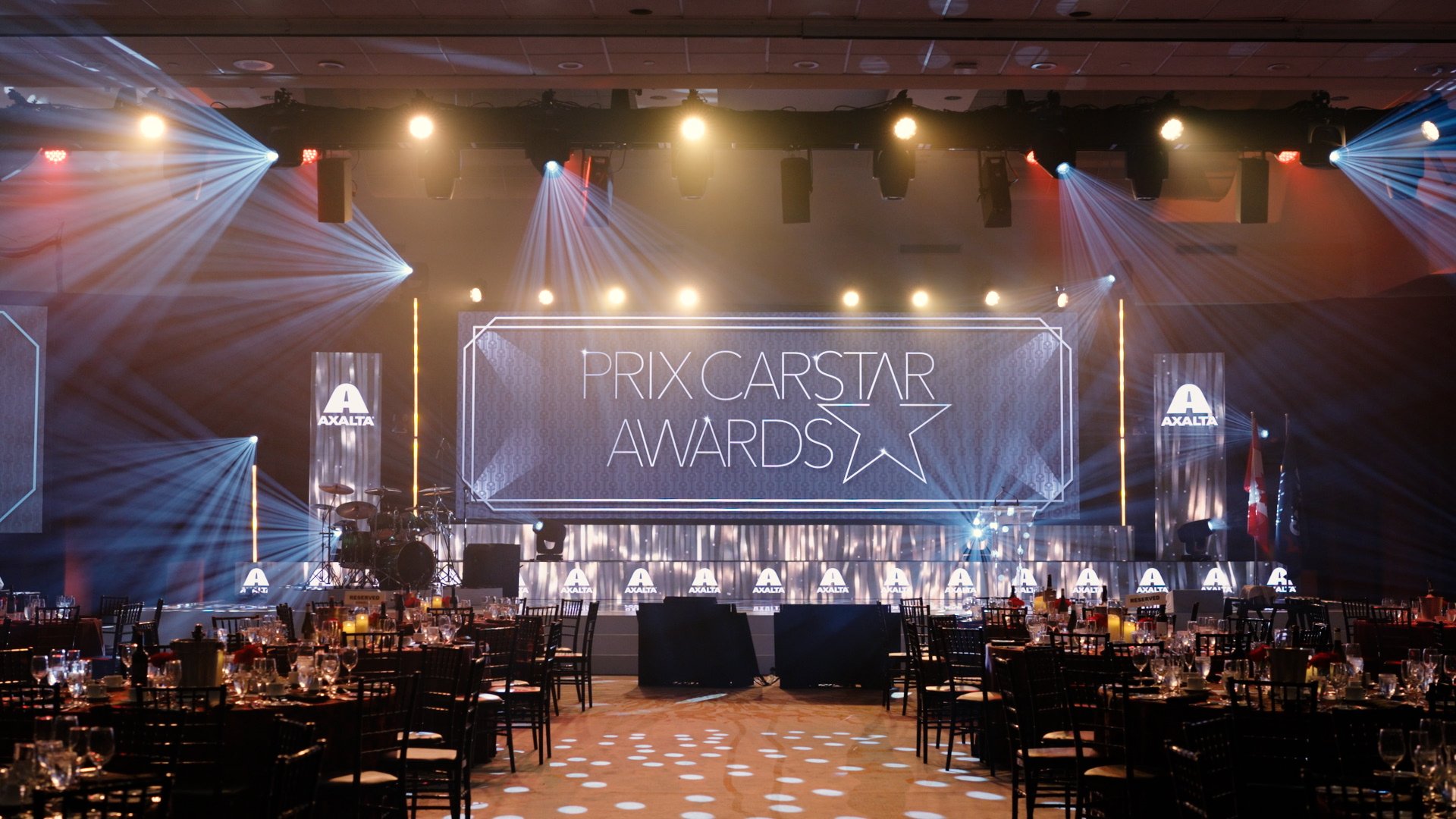
Unlike a one-hour conference session where a podium mic and single screen suffice, a Toronto gala production operates as an integrated creative ecosystem: custom staging, intelligent lighting rigs, multiple video surfaces, a sophisticated audio environment managed in real-time, and a dedicated Toronto-based production team coordinating all elements across the full duration of your event.
At bb Blanc, galas and awards shows are core to our production portfolio. In 2025 alone, we executed 351 corporate events with a 100% client satisfaction rate—and a significant portion of those were formal galas and celebrations for organizations like Honda, TD Bank, and Thomson Reuters. We know the rhythm of these evenings intimately: the pacing, the high-stakes moments, the emotional arcs that stay with guests long after the final toast.
Production Design Strategy for Corporate Galas
When planning gala production in Toronto, think of the entire technical and creative infrastructure as a unified production system. Every element—stage, lighting, audio, video, content, talent coordination, show direction—serves the overarching brand narrative while delivering flawless execution in its own domain.
This is where creative production partners differ fundamentally from equipment providers. We don't start with a checklist of AV specs. We start with your vision, then design the production strategy around it.
Stage Design & Creative Concept
Your stage is the visual anchor for every memorable moment—and designing it requires collaboration between creative direction and technical feasibility. In Toronto's competitive event landscape, your stage design becomes a crucial differentiator.
A Toronto gala stage must balance visibility, brand storytelling, and operational flexibility:
Sightlines first, always.
Every seat—from front row to back—must have an unobstructed view of the stage and any primary screens. We recommend positioning key focal points (award display, executive seating, speaker area) higher than eye level and toward the center of your venue. This ensures every guest feels included.
Branded visual identity.
Incorporate your organization's logo, color palette, and design language into the stage surround through custom draping, scenic elements, or architectural features. This reinforces brand identity continuously throughout the evening and ties the production to your broader marketing narrative.
Flexibility for rapid transitions.
Your stage will host award presentations, executive remarks, live entertainment, and possibly band or DJ performance. Design the layout to accommodate quick transitions—speaker to performer, awards display to entertainment area—without breaking visual flow or requiring distracting crew movement.
Depth and layering create visual drama.
Multi-level staging separates different segments visually and creates spatial interest. A raised stage for awards, a lower performance platform for entertainment, or angled sightlines all contribute to production polish.
For more ideas on creative staging, see our guide on creative stage decoration ideas for corporate events. We also recommend reviewing our guide on event production company Toronto for additional insights. 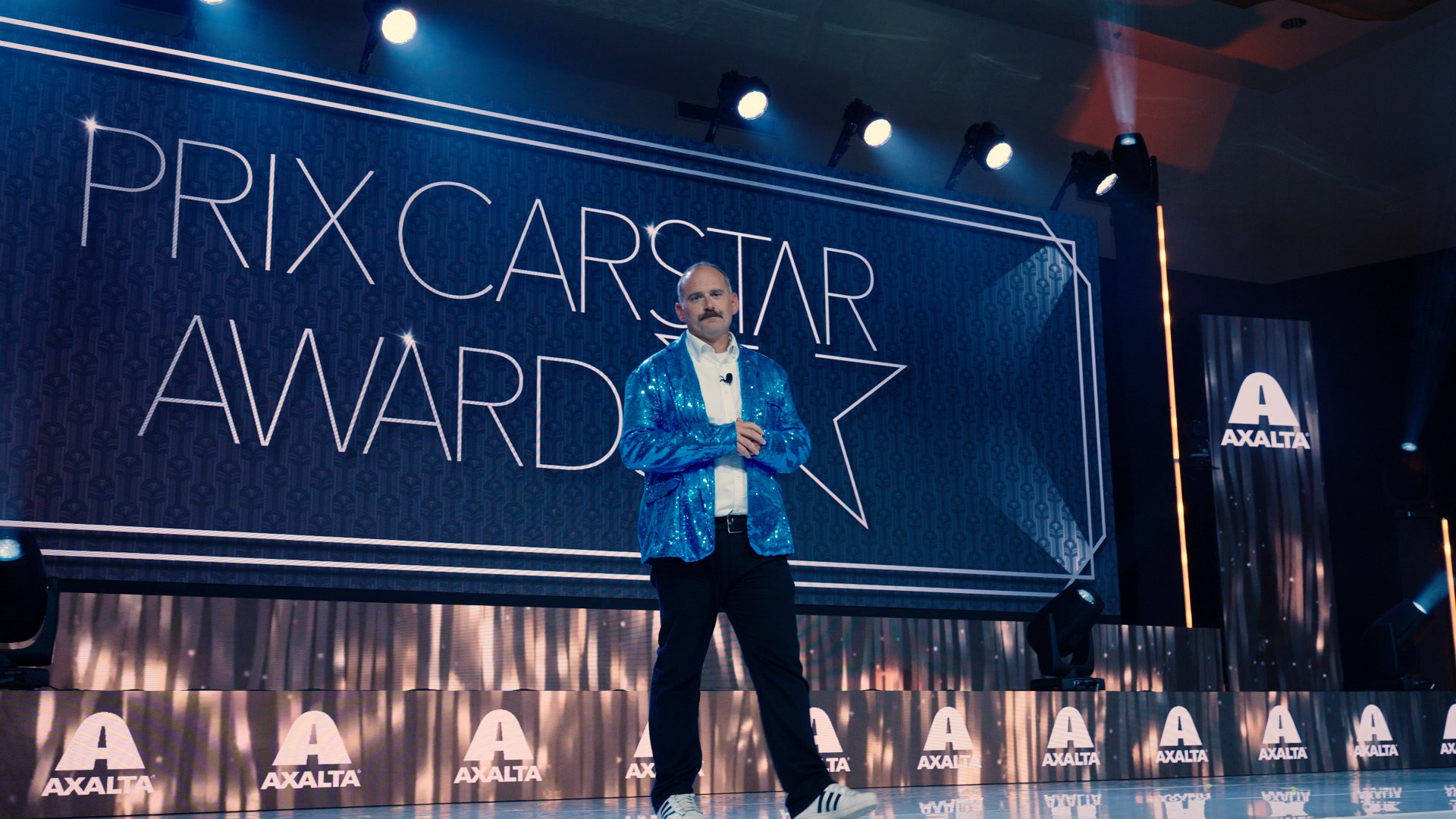
Lighting Design as Mood & Direction
Lighting is not decoration. It's the medium through which you control emotional tone, direct guest attention, and establish production credibility. In a Toronto gala setting, sophisticated lighting design separates premium events from standard productions.
Strategic lighting design for a Toronto corporate gala integrates technical precision with creative intention:
Foundational ambient lighting.
Soft, warm uplighting on drapes and architectural elements creates a sophisticated baseline atmosphere. Typically 2,700–3,200K color temperature conveys intimacy and formality. This is the visual baseline against which all other lighting moments read.
Stage wash for speaker clarity.
Dedicated front-of-house lighting illuminates speakers and performers evenly, minimizing shadows and ensuring video cameras—both IMAG and content cameras—capture clean, broadcast-quality content. Your show director coordinates this with camera positions in real-time.
Accent lighting for visual hierarchy.
Strategic spotlights, custom gobos (projected patterns), or moving lights on key set pieces—logo, awards display, band area—draw the eye and guide narrative flow. These are cues, in a theatrical sense.
Transitions that signal energy shifts.
Subtle color temperature changes or intensity shifts between dinner, awards, and dance segments signal energy transitions to guests without jarring them. This is show production pacing.
Redundancy as risk management.
Backup dimmer systems, circuit redundancy, and failsafe protocols are built-in. A gala can't afford lighting failure mid-event—your production team has contingency for every critical system.
For intimate galas under 200 guests, we favor warm amber tones and architectural uplighting that creates warmth without feeling theatrical. Strategic gobo projection can add sophistication without overwhelming the space. For large ballrooms, we deploy intelligent lighting rigs with color temperature shifts between segments—cooler tones during cocktail hour, warmer ambers during dinner remarks, energetic color sequences for celebration moments. Every circuit is backed by redundant dimmers and power distribution, so a single failure never dims your moment.
Audio Production & Real-Time Management
Sound design for a gala must be clear, balanced, and dynamic—with a skilled audio engineer managing levels and transitions throughout the evening. Poor audio undermines every other production element and damages organizational credibility faster than any other technical failure.
Audio production for Toronto gala events requires:
Microphone strategy and redundancy.
Plan for multiple microphone types: podium mics for static positions (awards, remarks), wireless lavalier mics for speaker mobility, backup handhelds for emergency coverage. Test all wireless systems 48 hours before the event for interference, battery life, and frequency coordination. Have 2–3 fully charged wireless mics ready on stage at all times, with a hardwired podium mic as ultimate fallback.
Music integration and curated transitions.
Whether your music comes from a DJ, live band, or background tracks, each segment requires intentional transition. Audio mixing must be dynamic—louder during cocktail hour, pulled down during dinner remarks, energetic for dancing. A skilled audio engineer manages these transitions in real-time based on the room's energy and the show director's cues.
Announcements clarity above all else.
Executive remarks and award announcements must be crystal clear. Use high-quality microphones, a skilled audio technician managing levels, and test every speaker's vocal style during rehearsal. Feedback prevention requires careful frequency coordination and stage monitor setup (if used).
Speaker system placement for even coverage.
Main speakers should reach all seating areas evenly. Delay speakers in the back ensure timing coherence—the sound from the stage should arrive at rear seating at the same moment guests near the front hear it.
Content audio for video and entertainment.
Pre-recorded content, video playback, entertainment backing tracks, and DJ audio all flow through the main mixing console. One skilled audio engineer ensures smooth transitions and prevents audio conflicts that create confusion.
Video Production & Image Magnification
High-quality video reinforces key moments, ensures guests far from the stage don't miss crucial presentations, and creates opportunity for branded content. (For Toronto corporate events with product launch or trade show components, see our guide on product launch events using AV to wow your audience.)
Video production for a Toronto gala typically includes:
IMAG (Image Magnification) screens for presentation reinforcement.
A large rear-projection or LED screen behind the stage showing close-ups of speakers, award presenters, and performers. Essential for venues with poor sightlines or guest counts over 300. Your camera operator works with the show director to frame shots that reinforce rather than distract from the live moment.
Branded content loops during transitions.
Video content—company highlights, mission statements, achievement montages—plays during cocktail hour and between segments to reinforce brand narrative and fill dead time. This content is curated to match your gala's visual identity and production tone.
Pre-recorded and live talent integration.
Executive video messages, sponsor spotlights, performance backing tracks, and multimedia award presentations are all coordinated through your video production system. A skilled camera operator and video technician manage playback and switching, with backup systems ready for failover.
Content curation for production polish.
All video content—resolution, color grading, aspect ratio, pacing—should align with your gala's visual identity. Low-resolution or tonally mismatched content reads as unprofessional and breaks the branded experience you've worked to create.
LED Walls & Dynamic Visual Surfaces
For larger Toronto galas (500+ guests) or venues with challenging sightlines, LED walls offer the flexibility, brightness, and visual impact that traditional projection can't match. Many Toronto venues benefit from this technology.
LED advantages in gala production:
Dynamic content capability.
RGB LED technology allows real-time color shifts, branded sequences, and content updates during the event. Your show director can cue lighting changes, video content updates, and visual effects in real-time without pre-programming everything.
Brightness independent of ambient lighting.
Venue lighting won't wash out LED content like it might with projection. Your video content remains crisp and readable regardless of how bright you light the room.
Modular and scalable design.
LED can be configured in various sizes and shapes to fit your stage design, create multiple viewing surfaces, or support curved architectural staging. This flexibility allows creative staging that standard projection can't achieve.
Dual-purpose display efficiency.
One LED surface often serves as both IMAG (close-up video of speakers) and decorative backdrop (branded content, lighting effects), reducing visual clutter and simplifying content management.
A typical LED configuration for a Toronto gala: A 4m × 2.5m main screen behind the stage, possibly flanked by smaller accent screens for side sections or a curved edge design for visual drama.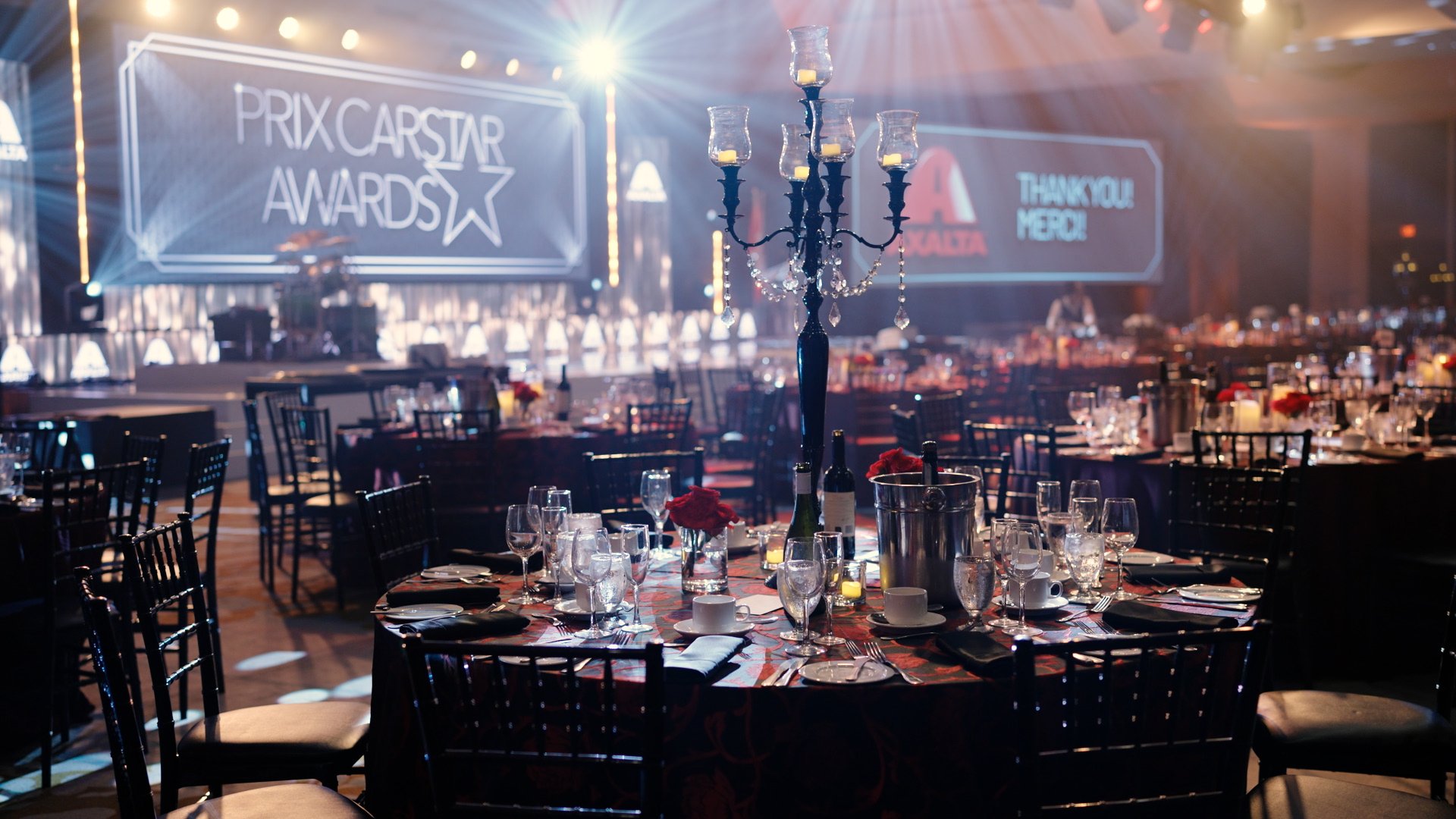
How Creative Production Planning Shapes Your Gala Timeline
Gala production timelines in Toronto are longer than equipment rental timelines—and they're essential for creative development, content creation, rehearsal, and risk mitigation. (For conference-specific timelines, see our guide on how to plan audio visual for corporate conferences in Toronto.)
The timeline below reflects production partnership, not transactional vendor management.
8–10 Weeks Before: Creative Discovery & Strategic Planning
This is where your gala production in Toronto truly begins—with creative conversation, not equipment specs.
Vision alignment workshop.
Meet with your production team to define the gala's core message, audience experience, and emotional tone. Are you celebrating company achievements? Honoring leadership? Fundraising? Building community? This clarity shapes every production decision downstream.
Venue analysis and technical planning.
Your production team conducts a detailed site survey: ceiling height (for rigging), load-in access and timing, electrical capacity, acoustic characteristics, sightlines from every seating area, and WiFi/network infrastructure if needed. This informs what's possible and what requires creative workarounds.
Program structure and segment timing.
Lock down the gala flow: cocktail reception (duration?), dinner (any remarks?), awards (how many segments?), entertainment (live band, DJ, or recorded content?), dancing (how late?). Estimated timing for each segment drives creative pacing and production resource planning.
Brand visual language and design direction.
Develop the gala's aesthetic—color palette, design style, typography, imagery. This becomes the creative brief for all subsequent design work: stage design, lighting mood, video content styling, and overall visual coherence.
6–8 Weeks Before: Creative Design & Content Strategy
Design and content creation ramp up—this is where your production vision becomes tangible.
Stage and lighting design development.
Create technical drawings with sightline diagrams, rigging plans, and color specifications. Source or build custom staging elements. Plan intelligent lighting plots with specific cues for each segment. Your production team collaborates with your internal team to refine design until it feels right.
Audio visual scope and integration planning.
Finalize the AV specification: How many screens? What resolution, brightness, and placement? How many wireless microphones? What's the audio mixing complexity? What content surfaces will you need? How does all this integrate into the overall stage design?
Video content strategy and production calendar.
Create a detailed outline of video content: awards intros, speaker spotlights, brand montages, performance backing tracks, IMAG strategy. Establish a production calendar—who's providing source material? When are drafts due? How many revision rounds? Your production team may handle creation in-house or coordinate external vendors.
Talent coordination and artist requirements.
If you're featuring live entertainment, confirm performers, finalize contracts, and begin technical rider review. What do they need from your production team? Stage setup? Sound system specs? Lighting requirements? Build this into your show plan.
Show production roadmap.
Create a master timeline for load-in, technical rehearsal, speaker prep, and show day execution. Confirm dates with your venue. Establish who's responsible for each element.
4–6 Weeks Before: Technical Planning & Detailed Design
This is where creative concepts meet technical precision.
Finalized creative renders and technical drawings.
Deliver visual renderings of the stage design, lighting mood, video content drafts, and overall ambience. These become your north star for approval and team alignment.
Detailed technical specifications and vendor coordination.
Create the complete AV and production specification: lighting rig details, speaker system design, video switching architecture, wireless microphone frequency plan, power distribution, backup systems, and redundancy strategy. Share with all vendors for alignment.
Video content development in final form.
All awards intros, spotlights, brand montages, and performance backing tracks are complete and formatted for playback. Color grades and aspect ratios match your gala's visual identity.
Speaker and talent briefings.
Begin one-on-one briefings with speakers and performers. Cover microphone technique, stage positioning, timing, teleprompter or script approach, and any special technical needs. These conversations prevent day-of surprises.
Run-of-show document creation.
Develop a comprehensive minute-by-minute script for your entire gala, including: lighting cues (when do colors shift? when do effects trigger?), audio cues (when does music change? when are wireless mics live?), video playback timing, camera movements, talent exits and entrances, and show director call sequence. This becomes the control document for your production team.
2–4 Weeks Before: Refinement & Rehearsal Prep
Technical execution planning and team alignment.
Complete video content finalization and cueing.
All files reviewed, formatted for your playback system, cued with precise timecode, and tested for quality. Your video technician creates backup copies and documents playback sequence.
Full technical system testing in production facility.
If possible, your production team tests critical systems in-house: lighting sequences, audio mixing under load, video switching and camera control, wireless microphone interference, and LED content playback. This identifies issues before they appear at your venue.
Speaker and performer dress rehearsal.
Conduct a run-through with key speakers and entertainers, if possible. Full stage, microphones, lighting, and video. Time everything. Identify awkward transitions or timing issues. Let speakers practice with your actual sound system and stage setup.
Contingency planning and failover protocols.
Identify potential failure points: What if a wireless mic fails? If video playback stalls? If LED screen has a technical issue? Document fallback options and train your crew on execution.
Final vendor coordination and contract confirmation.
Ensure all vendors—staging, lighting, audio, video, talent management, catering AV, valet, security—are aligned on timing, deliverables, and contingency responsibilities.
Load-In & Technical Rehearsal (1–2 Days Before)
This is where all the planning becomes reality—and where your production team earns its value through flawless execution and problem-solving.
Stage construction and rigging.
All custom staging elements, draping, scenic pieces, and lighting rigs are installed and secured. Rigging follows safety protocols (we use 5:1 safety factor and dual brake motors). Sightlines are verified from multiple seating positions.
Audio visual system build-out and integration.
All speakers, microphones, cameras, screens, LED walls, and switching infrastructure are positioned, connected, and tested. Network systems and WiFi infrastructure are deployed if needed.
Lighting plot execution and programming.
All dimmers, fixtures, and intelligent lighting consoles are wired and programmed. Each lighting cue from your run-of-show is tested and refined. Your lighting designer works with the show director to ensure mood and timing are perfect.
Full system dress rehearsal with your entire run-of-show.
Run through every segment of your gala with live audio, lighting, and video—as close to the real event as possible. Speakers deliver actual remarks. Entertainment performs. Video plays on cue. Your show director calls the shots in real-time. Problems are identified and solved.
Final walkthrough and stakeholder approval.
Review sightlines, audio clarity, lighting ambience, video playback timing, and production flow with key decision-makers. Make final adjustments. Confirm everyone is confident in execution.
Common Gala Production Mistakes (and How to Avoid Them)
From our experience producing galas across Toronto, the Greater Toronto Area, and Canada, we've identified the gaps that separate memorable events from forgettable ones:
Underestimating audio complexity and management.
Galas involve multiple audio sources—DJ or band, speeches, pre-recorded content, ambient music, talent performance audio—all requiring real-time mixing and transition management. Without a dedicated, skilled audio engineer actively mixing throughout the event (not just operating equipment), you risk muddy audio, awkward transitions, or feedback during critical moments.
Solution: Partner with an audio production team, not just equipment rental. Your audio engineer should attend all rehearsals and understand your show flow.
Poor sightlines or video content placement.
A screen positioned too high, too far away, or at the wrong angle reads as distant and disconnected. Guests in certain sections miss critical presentations.
Solution: Conduct a detailed sightline audit during your venue layout phase. Position screens at eye level for the majority of seating. Test actual video content on your chosen screens during technical rehearsal under the actual lighting conditions.
Insufficient wireless microphone redundancy and backup strategy.
A speaker's wireless mic fails mid-award and your backup is in the tech booth, requiring an awkward crew interruption.
Solution: Stage multiple fully charged, tested wireless mics at all times. Maintain a hardwired podium mic as ultimate fallback. Your audio engineer should have a clear protocol for mic handoffs and backup activation.
Lighting and video design conflicts.
Bright blue ambient uplighting washes out video content, making it look unprofessional. Darker lighting creates a mood but makes presentations hard to see.
Solution: Coordinate lighting and video design from your initial creative planning. Test your chosen lighting palette with actual video content on your selected screens during technical rehearsal. Adjust as needed.
Overly complex transitions with too many simultaneous cues.
Five lighting states, three video sources, talent entrance, music cue, and speaker introduction—all triggered at once. When one element misfires, the entire sequence cascades.
Solution: Build buffer time between major segments. Simplify transitions to one primary action per moment. Use detailed checklists for crew. Conduct full dress rehearsals to identify weak points and refine timing.
Forgetting speaker rehearsal with actual production elements.
An executive surprised by actual stage positioning, podium height, screen distance, or lighting during the live presentation creates awkward, unpolished moments.
Solution: Schedule a dedicated 15–30 minute walk-through with every speaker and talent during your technical rehearsal. Let them experience the actual stage, lighting, screens, and audio mix. Build confidence through familiarity.
Our track record speaks for itself—99.2% success rate in 2024, 100% in 2025 across 600+ events. That consistency isn't accidental. It comes from non-negotiable rehearsal: the show caller, lighting designer, and audio engineer all rehearse with your speakers before the event, running through awards presentations, transitions, and every technical cue. We identify issues when there's time to solve them, not at 8 p.m. on event night. And our redundancy is built in by design—backup switchers, battery backup on every audio console, redundant cabling runs throughout the venue. If a system fails, you never see it happen.
Partner with bb Blanc for Gala Production in Toronto
A corporate gala is one of the most important events your organization can host. It's where you celebrate your people, connect with stakeholders, reinforce your brand, and create memories that shape how the world sees you.
The production elements—creative design, show direction, technical execution—need to reflect that importance.
Since 2008, bb Blanc has been one of Canada's leading independently owned creative production companies. Our philosophy is simple: The Experience is Everything.
With 18 years of production expertise, a team of 82 in-house professionals plus 200+ specialized freelancers, and a 45,000 sq ft production facility with full equipment ownership and 24/7 operations, we bring the infrastructure, creative depth, and production discipline that Toronto galas demand.
Our approach is fundamentally different from equipment rental:
In-house creative + technical teams collaborate from concept to execution.
Your gala isn't built by handing specs to different vendors. Our creative designers, technical directors, show directors, and production managers work as one team, integrated around your vision.
Dedicated account management for the entire project timeline.
No hand-offs. No surprises. Your project manager owns your event from initial conversation through post-event debrief. You work with the same person—someone who understands your vision, knows your stakeholders, and carries accountability for success.
Studio 41 content production capability.
Our dedicated broadcast and content studio (896 sq ft, 34 control stations) means your gala's video content is produced with technical delivery in mind from day one. Visit studio41.ca for details.
Production experience across Canada and the United States.
From Toronto galas to Vancouver conferences, Las Vegas product launches, and large-scale productions for 5,000+ audiences, we deliver the same production discipline and attention to detail everywhere we work.
Proven track record.
Over 99% client satisfaction across more than 500 corporate events over the past two years speaks to our execution rigor.
We operate across Canada—with headquarters in Toronto and active production in Vancouver, Ottawa, Montreal, Quebec City, New Brunswick, and Prince Edward Island—and in the United States, with teams in California, Las Vegas, Colorado, Florida, and Texas.
Ready to start planning your next Toronto gala with a production partner who understands both creative vision and technical execution? Contact our team today.
Frequently Asked Questions

