



There's a gap between having equipment and orchestrating an event that lands.
We've watched Toronto organizations spend months planning a conference, gala, or product launch—only to find themselves scrambling on event day because they hired based on equipment list instead of production capability. The difference isn't subtle. It's the difference between a vendor and a partner.
This guide walks you through what a full-service event production company actually does, how to evaluate candidates, and the specific advantages of working with Toronto-based production expertise. Whether you're planning your first major event or your tenth, getting this decision right matters.
When searching for an event production Toronto partner, the distinction between a full-service audio visual Toronto production company and an equipment supplier is critical. The right audio visual production company Toronto organizations trust will manage creative, technical, and logistical execution as a single integrated service. Look for an AV production Toronto company with national reach that operates as a national event production company Canada clients can rely on for consistent quality across cities. The best partners also hold deep audio visual GTA expertise, covering events from downtown Toronto to corporate campuses across the Greater Toronto Area. A true corporate event production Toronto partner takes ownership of outcomes, not just equipment delivery, and treats event production Toronto as a craft rather than a transaction.
Event Production Company vs. Planner vs. Equipment supplier
The titles sound interchangeable. They're not. Understanding the distinction is your first checkpoint.
Event Planners manage timelines, vendor coordination, and logistics (catering, seating, invitations). They orchestrate the event flow and guest experience. They're generalists managing 20+ moving pieces simultaneously.
Equipment Equipment providers own and deploy AV gear. They deliver projectors, speakers, screens, and lighting on schedule and pick them up afterward. They don't design the experience or troubleshoot on the fly if something fails.
Full-Service Event Production Companies design and execute the technical vision that brings your event to life. They handle creative strategy, technical production, content creation, equipment deployment, crew management, and day-of technical direction.
Most events benefit from all three players working together. The problem: planners rarely have the technical depth to brief equipment companies effectively, and equipment suppliers rarely have the creative autonomy to innovate. A full-service production partner fills that gap. This is especially important for complex environments like LED video wall installations or large-scale conferences requiring comprehensive AV planning.
Core Production Capabilities
When you're evaluating an event production company, these are the core capabilities that separate professionals from generalists.
Creative Design and Concept Development
A production company should translate your event's objectives into a technical and creative brief. This means:
- Audience analysis: Who are they? What do they need to see, hear, and feel?
- Venue assessment: How do the space's dimensions, sightlines, and infrastructure constrain or enable your vision?
- Technical specifications: Screen sizes, speaker placement, lighting positions, and interactive elements based on actual venue conditions—not guesswork.
- Content mapping: What content appears where, in what sequence, and for how long?
Many events fail because the production company never had a design conversation. They just showed up with standard setups. That's not production—that's delivery.
Technical Production and Engineering
This is the backbone. It includes:
- Audio engineering: Microphone selection and placement, speaker coverage mapping, mixing, monitor systems, assistive listening systems for accessibility.
- Video production: Camera switching, graphics integration, real-time content playback, video engineering for multiple screens or projection mapping.
- Lighting design: Practitioner-level design (not automated presets), dimming system programming, fixture placement for coverage and aesthetics, gobo design.
- Rigging and structural engineering: Understanding load-bearing capacity, sight lines, cable routing, and safety protocols specific to your venue.
- Network and streaming infrastructure: Hardwired backup systems, Wi-Fi load capacity, encoding for streaming, remote participant integration.
Any company that doesn't ask detailed technical questions upfront isn't doing engineering. They're configuring.
Content Creation
Content creation is often overlooked as part of production. A capable production company should offer:
- Motion graphics and animation: Opening sequences, sponsored segments, lower-thirds, animated data visualization.
- Video production: Pre-recorded segments, testimonial videos, edited content integration.
- Photography and capture: On-site documentation with broadcast-quality cameras, not a smartphone.
- Asset management: Organizing, versioning, and delivering content throughout the event lifecycle.
If your production company outsources all content to freelancers, you lose operational continuity. Content and technical production need to work from the same strategic playbook.
Logistics and Project Management
The execution layer includes:
- Load-in and setup scheduling: Sequencing equipment delivery and installation to minimize venue disruption.
- Crew coordination: Assigning technicians, stage managers, and support staff with role clarity.
- Equipment inventory management: Tracking thousands of pieces from warehouse to venue and back.
- Insurance and permits: Ensuring liability coverage, rigging inspections, and compliance with local regulations.
- Contingency planning: Backup systems, fallback procedures, and problem-solving protocols.
This is what separates organized events from chaotic ones.
Day-of Technical Direction
On event day, a production company should have:
- Show calling and cue coordination: A technical director managing timing, transitions, and live problem-solving.
- Multi-disciplinary communication: Clear comms between audio, video, lighting, and stage management teams.
- Real-time decision-making: Responding to technical issues, timing changes, and unexpected situations.
- Client interface: A dedicated liaison between the production team and event stakeholders.
How to Evaluate Production Partners
The vendor shortlist is narrowed. Now, how do you actually vet them?
Portfolio Assessment
Ask to see case studies from events similar to yours in scale and complexity. Look for:
- Event type diversity: Have they done galas, conferences, product launches, annual meetings? Different event types require different expertise.
- Venue diversity: Have they worked in Toronto hotels, convention centers, outdoor venues, and nontraditional spaces? Adaptability matters.
- Technical complexity: Check if they've managed events with streaming, international participant integration, multiple breakout sessions, or interactive displays.
- Result documentation: Can they show you photos, video clips, or testimonials from previous clients?
Be skeptical of generic portfolios. A company that claims to excel at everything probably excels at nothing.
Site Visits and Conversations
Don't evaluate companies based on email or a phone call. Visit their office or facility. Observe:
- Team structure: Who are the principal technicians? How long have they worked together?
- Equipment facility: Is their gear well-maintained? Is their warehouse organized and documented?
- Problem-solving capability: Ask a technical question specific to your venue. Do they think through constraints, or do they give you a generic answer?
- Communication clarity: Do they ask detailed questions about your objectives, or do they start pitching solutions?
-
The best production companies ask more questions than they answer in initial meetings.
What to Look For During Your Site Visit:
Team Cohesion and Depth A production company's strength lives in its team. When you visit: - Are the same people who will work your event present and engaged, or are you talking to sales only? - How long have key technicians worked together? Teams that have been together 5+ years develop intuition and trust that new teams don't have. - Do they have documented processes, or do they rely on tribal knowledge? - What's their approach to professional development? Do they invest in training and certifications, or just deploy the same people year after year?
Equipment Condition and Inventory - Walk their equipment warehouse. Is gear organized, labeled, and clearly documented? - Do they maintain equipment regularly (cleaning, calibration, testing)? - Can they quickly locate equipment and explain what it's used for? - Do they have redundancy built in (backup projectors, backup microphones, spare parts)? - Are there obviously obsolete pieces taking up space, or is their inventory current and mission-critical?
Technical Culture and Problem-Solving Ask them a specific technical question about your venue: "Our ballroom is 80 feet wide and 40 feet deep, with 12-foot ceilings and pillars every 20 feet. We expect 600 people for a gala with a 10-person band and video presentations. What would your approach be?"
Listen carefully. A good company will: - Ask follow-up questions (sight lines, lighting control, power access, audio needs) - Identify constraints and challenges (pillar obstruction, ceiling height limitation) - Propose solutions that address those specific constraints - Explain tradeoffs (if we do X, that affects Y) - Be honest about what's difficult or impossible
A mediocre company will give a generic answer ("We'd use two screens and standard sound system") that doesn't address your specific situation.
Reference Checks
Call at least two previous clients. Ask:
- Did the production company deliver on its creative vision? (Not just "Did the event happen?")
- Were there technical problems, and how were they handled?
- Did the team communicate proactively or wait for problems to emerge?
- Would you hire them again?
- What surprised you—positively or negatively?
References reveal patterns. Three different clients mentioning "great communication but expensive" tells you something. Three mentioning "saved our event when the main projector failed" tells you something else.
Insurance and Legal Compliance
Confirm:
- General liability insurance: Minimum variesM coverage.
- Equipment insurance: What's covered in transit and on-site?
- Workers' compensation: If they have employees.
- Permits and certifications: Rigging certifications, OHSA compliance, local permits for your venue.
Cutting this corner is how you expose yourself to liability. Don't.
The RFP Process
An RFP (Request for Proposal) gives production companies the information they need to quote accurately and forces you to clarify your own requirements.
What to Include in Your RFP
Event Basics - Event date, time, duration, and venue name - Expected attendance (in-person and remote, if hybrid) - Event objectives and key messages - Audience demographics
Technical Requirements - Proposed staging setup (dimensions, elevation, sightlines) - Audio needs (number of microphones, speaker coverage area, interpreted languages if applicable) - Video requirements (screens, projectors, IMAG, streaming) - Lighting scope (stage lighting, ambiance, special effects) - Any interactive elements (audience polling, video conferencing, virtual booth integrations)
Content and Timeline - Content you've already created (slides, videos, graphics) - Content the production company needs to create - Key timing requirements (keynote speeches, demo windows, break times)
Success Metrics - What would make this event successful for you? - Are there specific technical risks you're concerned about?
Budget and Timeline - Your timeline for vendor selection - Budget range (without specific numbers, you can say "mid-range corporate event budget" or provide context) - Approval process and decision timeline
What to Expect Back
A professional RFP response should include:
- Confirmation of understanding: Did they capture your objectives accurately?
- Proposed approach: How will they deliver your technical vision? What makes their approach suited to your event?
- Detailed scope of work: What's included? What's optional or additional?
- Team and resources: Who will be involved? What's their experience?
- Timeline and logistics: Load-in schedule, crew arrival times, day-of coordination plan.
- References: At least two similar events they've produced.
If a production company sends back a generic proposal with no evidence they understood your specific event, move to the next candidate.
Evaluating RFP Quality
Red Flags in Responses:
Generic language that could apply to any event - "We will provide a comprehensive AV solution" tells you nothing. - Good responses mention your specific event: "For your 600-person gala in the King Edward room, we recommend two 18-foot projection screens angled to address the pillar obstruction..."
Vague timelines or missing technical details - "Load-in: TBD" means they haven't actually thought through logistics. - Good responses specify: "4-hour load-in starting at 2pm. Main screen rigging requires a certified rigger and 2 stage hands. Audio setup occurs in parallel and takes 3 hours."
No contingency or risk discussion - If the proposal doesn't mention what happens if systems fail, they haven't planned properly. - Good responses include: "Primary projector is backed by a secondary unit. If the main fails, we switch to secondary within 60 seconds. Audio system has dual mixing consoles configured identically."
Scope creep or hidden costs - If everything is bundled and priced as a lump sum with no breakdown, you can't understand value. - Good responses itemize: setup labor, equipment sourcing, content creation, day-of crew, contingency systems—so you see what's being provided and can make tradeoff decisions.
Minimal engagement or questions - If they didn't ask clarifying questions, they didn't deeply consider your event. - Good responses show evidence of research: "We note you mentioned 'intimate gala for 300.' We're recommending modest technical scope to keep focus on your speakers and ambiance. Here's what that means..."
Evaluating Experience Match
When they reference past events, dig deeper:
- Event scale: Have they done events of your size? A company experienced in 100-person meetings might be unprepared for a 1,000-person conference.
- Technical complexity: Have they managed the type of technical integration you need? (If you're doing simultaneous interpretation, make sure they've handled that. If you're streaming, make sure they've managed streaming infrastructure.)
- Venue type: Have they worked in venues similar to yours? A company experienced in hotels might struggle with outdoor spaces. A company experienced in theaters might be unfamiliar with corporate ballrooms.
- Client type: Have they worked with similar organizations? A company experienced in entertainment events might not understand corporate culture and expectations.
Ask for references from the past 12 months, not "some past events." Recent references are more accurate predictors of current capability.
Toronto-Specific Production Advantages
If you're based in Toronto, working with a local production company isn't just convenient—it's strategically smart.
Venue Relationships and Facility Knowledge
Toronto production companies with 10+ years of history know the city's event venues at an intimate level. They know:
- Technical infrastructure: Which venues have adequate power, rigging points, and acoustics. Which ones require creative workarounds.
- Load-in logistics: Traffic patterns, dock constraints, union labor rules at specific venues, and setup timelines that account for local realities.
- Venue relationships: Direct contact with facility managers, A/V coordinators, and operations teams. This speeds up approvals and problem-solving.
Crew Depth and Reliability
Toronto has a deep bench of experienced AV technicians, stage managers, lighting designers, and video engineers. A production company with roots in the city can:
- Assemble teams quickly: No freelancer shortage or last-minute cancellations.
- Ensure consistency: The same people you work with have trained and worked together for years.
- Handle complexity: Multiple simultaneous events, large crews, or specialized technical needs don't strain resources.
Out-of-town production companies often rely on local freelancers they don't know. You get variable quality and coordination challenges.
Equipment Access and Local Supply
Major equipment inventory—LED walls, projection systems, rigging infrastructure, lighting fixtures, audio gear—is expensive. Local production companies justify that investment because they use it regularly across many events.
This means:
- Equipment is well-maintained: Regular use and maintenance cycles keep gear in top condition.
- Variety and specialization: They carry niche equipment (projection mapping rigs, wireless microphone systems, LED video walls in multiple configurations) that out-of-town vendors don't own locally.
- Faster deployment: No shipping delays. Equipment is staged locally and ready to go.
Union Considerations and Labor Compliance
Toronto's IATSE (International Alliance of Theatrical Stage Employees) presence means strict union labor rules for certain venues and event types. A local production company navigates this naturally. They know:
- Which venues require union labor: Convention centers (Metro Toronto Convention Centre), major hotels (Fairmont Royal York, Park Hyatt), and some corporate venues have standing union agreements.
- Union rates and hour minimums: They budget accurately and don't get surprised. A union technician has hour minimums (typically 4 hours minimum) and higher rates than non-union labor. A local company factors this into planning.
- Compliance requirements: Proper training, certifications, and reporting. IATSE work requires working under union protocols, which means specific crew breakdown and documentation.
- Negotiation and relationship: Long-term relationships with union halls means better scheduling and sometimes flexibility during emergencies.
An out-of-town company guessing at union rules is a recipe for cost overruns and scheduling conflicts. You could end up paying premium rates for labor you didn't budget for because the production company didn't anticipate union requirements.
Venue-Specific Knowledge
Toronto's event venues have unique characteristics that experienced production companies understand deeply.
Major Venues and Their Quirks:
- Metro Toronto Convention Centre: Massive dock access, excellent load-in, union requirements, excellent power infrastructure, multiple breakout rooms with varying connectivity
- Fairmont Royal York and Park Hyatt: Iconic venues with older electrical infrastructure (sometimes limiting for large AV rigs), beautiful ballrooms with ornate architecture (impact on rigging), strong venue relationships and in-house AV capabilities
- Distillery District: Unique industrial space with exposed brick, limited electrical infrastructure, loading constraints, but stunning for gala and product launch aesthetics
- Casa Loma: Historic venue with limited technical infrastructure, beautiful ambiance, structural constraints for rigging, backup power usually required
- Evergreen Brick Works: Industrial aesthetic, excellent for modern events, good loading, but limited electrical capacity and no HVAC in certain spaces (matters for large crowds)
A production company that's worked these venues regularly knows the gotchas. They know which ballroom at the Fairmont has the best sightlines. They know that Casa Loma requires generator backup because venue power isn't sufficient for modern AV. They know that Distillery District's artistic charm comes with electrical limitations.
An out-of-town company will guess. A local company knows.
Cost of Labor and Supply Chain
Toronto's AV and event production ecosystem benefits from density. Multiple equipment equipment providers, crew availability, and competitive pricing mean:
- Equipment availability: If one company doesn't have a specific LED wall size in stock, another does. Options and inventory depth.
- Crew depth: You're not competing with other cities for the same technicians. Toronto has a deep bench.
- Competitive pricing: Market competition keeps costs reasonable. Out-of-town companies might quote higher because they're managing travel and logistics.
None of this saves you money directly (production costs are production costs), but it gives local companies efficiency that they can pass along.
Red Flags When Choosing a Production Company
Some warning signs emerge early. Don't ignore them.
Vague or Generic Proposals: If their response to your RFP could apply to any event, they didn't read it carefully. Production requires specificity. A company that doesn't differentiate their approach to your unique event lacks depth.
Reluctance to Answer Technical Questions: If they deflect or say "we'll figure that out closer to the event," they're not planning properly. Good production companies ask technical questions upfront and provide solutions, not surprises. Pushback on technical requirements is a sign they lack expertise.
Equipment-First Thinking: If every conversation starts with "we have four LED walls, three projectors, and can do anything," they're thinking about inventory, not strategy. A production company should ask what you need, not pitch what they own. This approach often leads to over-specified solutions that don't match your actual objectives.
No Insurance or Permits: If they're vague about liability coverage, workers' compensation, or permit handling, walk away. This is not negotiable. Verify their insurance independently—don't just accept their word. A legitimate company should provide proof of insurance without hesitation.
Unwillingness to Provide References: Every legitimate production company has client references. If they don't, there's a reason. And if they provide references but those references are vague ("I can't quite remember the event details"), that's also a warning.
Communication Gaps During Planning: If they're hard to reach during the planning phase, they'll be invisible on event day. Communication discipline is predictive. You should see regular check-ins, proactive problem identification, and responsiveness to your questions during the entire planning period.
One-Person Shop or Minimal Team: Some one-person production "companies" exist. They can handle small events, but complex productions need teams with role clarity. If you can't identify the audio engineer, video director, and technical director, the company isn't set up for professional-grade events. Ask explicitly about crew depth.
Lack of Contingency Planning: Ask: "What happens if the primary projector fails?" or "How do you handle unexpected audience growth?" or "What's your process if internet fails during the stream?" If they don't have quick answers, they haven't thought about risk. Mature production companies have documented contingency plans for common failure modes.
All-Inclusive Pricing with No Transparency: If they quote a lump sum with no breakdown, you can't evaluate what you're paying for or make tradeoff decisions. Transparent pricing shows confidence. Opaque pricing often hides cost overruns or value extraction.
Overpromising or Oversimplifying: If they say "don't worry, we handle everything" without understanding your constraints, they're either inexperienced or dishonest. Every event has constraints. Acknowledging them is a sign of maturity, not weakness.
No Follow-Up or Post-Event Debrief: After the event, do they contact you to get feedback and discuss what worked and what didn't? Companies that care about continuous improvement debrief with clients. Companies that are just moving on to the next job treat events transactionally.
Partner with bb Blanc for Event Production in Toronto
At bb Blanc, we've produced hundreds of corporate events across Toronto—from 50-person board dinners to 5,000-person conferences. That experience informs every decision we make on your behalf.
We don't think about events as AV deployments. We think about them as strategic communication opportunities. Your event has a message. We're accountable for delivering it clearly, memorably, and professionally.
Our Production Philosophy
Our approach starts with strategy, not equipment. We ask about your objectives, your audience, and your venue constraints before we spec a single screen or speaker. Then we design a complete technical and creative solution that brings your vision to life.
We handle the full scope: creative design, content production, technical engineering, equipment provision, crew management, and day-of technical direction. You work with one partner, not five vendors trying to coordinate.
This matters because it creates accountability. We're not incentivized to over-specify equipment (more rentals, more revenue). We're incentivized to deliver your message effectively. Sometimes that's a simple setup. Sometimes it's complex. We recommend what your event actually needs.
Our Team and Experience
bb Blanc's founding team has 20+ years of event production experience. Our core crew includes:
- Audio engineers with expertise in everything from intimate boardroom acoustics to large-scale simultaneous interpretation
- Video directors experienced in live event capture and integration with complex content systems
- Lighting designers skilled in theatrical aesthetics and technical precision
- Technical directors who coordinate complex, multi-component events without visible stress
- Content producers who create compelling motion graphics and video that serves your message
- Project managers who keep timelines, budgets, and stakeholder expectations aligned
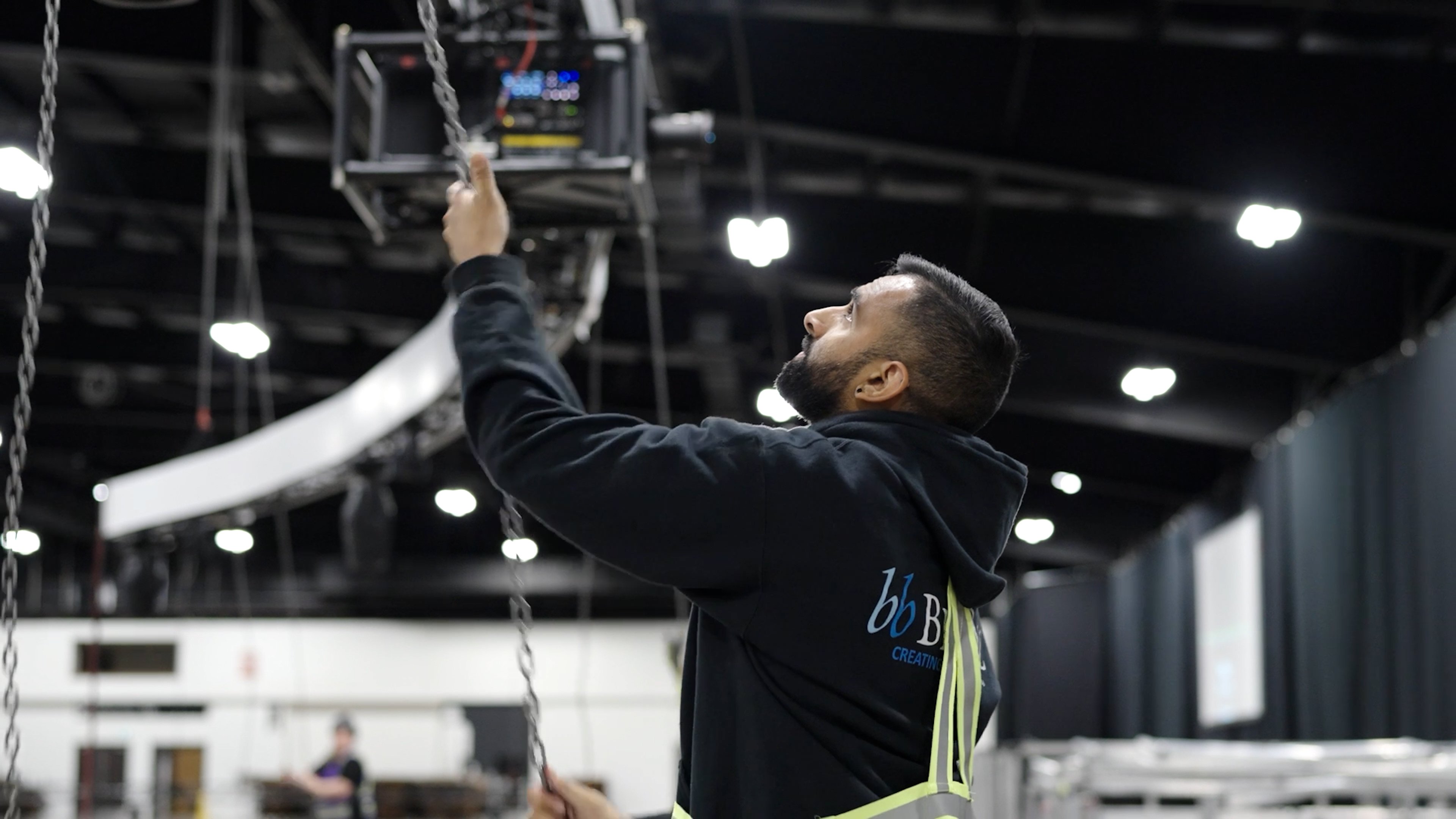
Crucially, this is a coordinated team that has worked together for years. We're not assembling freelancers for each event. We move as a unit, which means better communication, faster problem-solving, and consistency.
Our Capabilities
Strategic Consulting - We review your event objectives and help you define what "successful" looks like - We recommend venue options or assess your chosen venue - We identify technical requirements and tradeoffs - We develop a production strategy aligned to your budget and timeline
Creative Production - Motion graphics and animation for opening sequences, transitions, and graphics - Video production and editing for content integration - Lighting design creating the right ambiance and aesthetic - Audio system design for clarity and accessibility
Technical Implementation - Full audiovisual system engineering - Complete content management and playback - Real-time mixing and technical direction - Streaming and recording infrastructure (including hybrid events at Studio 41) - Accessibility design (assistive listening, ASL interpretation, captioning)
Project Management - Complete end-to-end coordination - Vendor management and coordination - Crew scheduling and logistics - Load-in planning and execution - Risk management and contingency planning
Learn more about our corporate AV and event production services For event production company Toronto expertise, we're also here to guide you through every decision point.
For hybrid or virtual components, Studio 41—our dedicated virtual events facility—gives you broadcast-quality production capabilities from a controlled environment, which simplifies remote participant integration significantly. Studio 41 is designed specifically for hybrid events where you need professional production quality alongside in-person participation.
Getting Started
Contact us with your event details. We'll: 1. Schedule a brief discovery call to understand your objectives and constraints 2. Review your venue and propose a technical approach 3. Provide a detailed scope of work and transparent overview of investment 4. Build a relationship, not a transaction
We're selective about the events we take on because we're committed to delivering excellence on every project. That selectivity is actually in your interest—it means we're not stretched thin or under-resourced.

